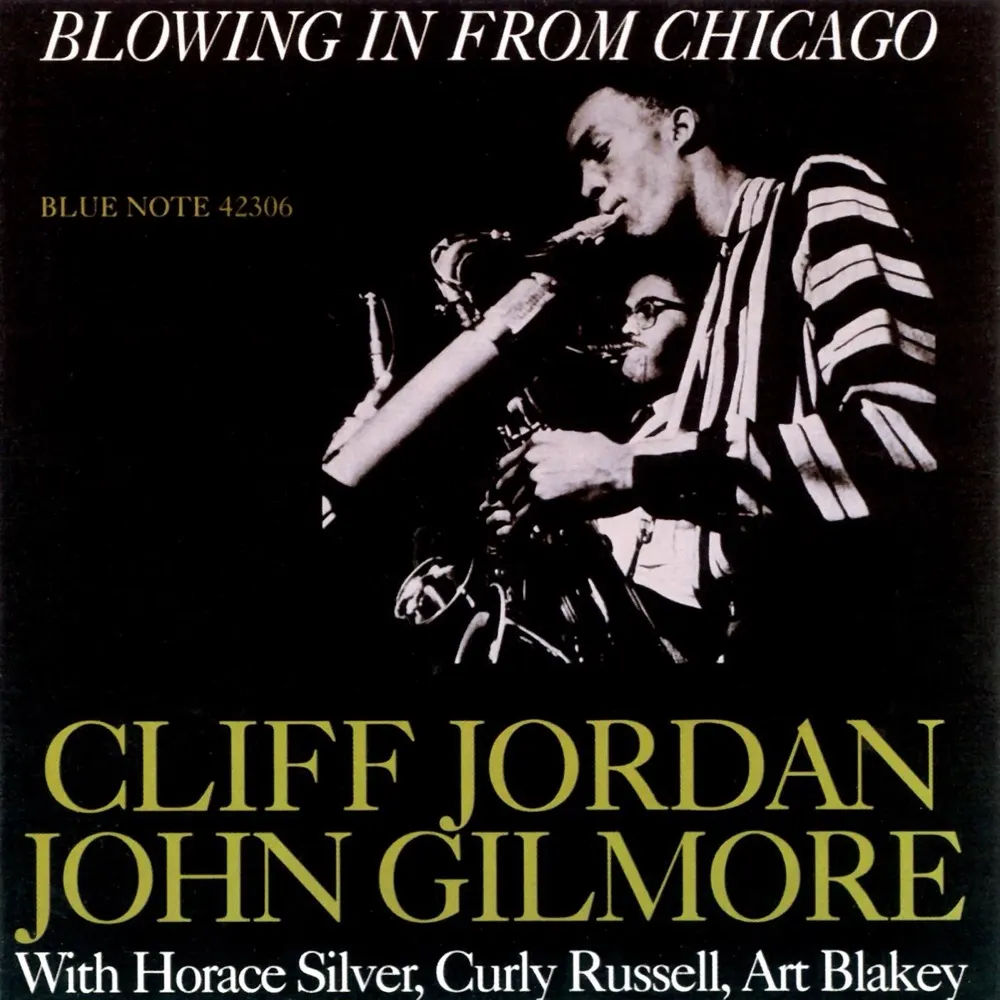
Clifford Jordan and John Gilmore were both 25, both tenor players, and both from Chicago's South Side. They had learned under the same teacher, Captain Walter Dyett, at DuSable High School. Joe Segal, in the original notes, sets them in a long line of Chicago tenors and passes on what John Coltrane told him about the city.
I haven't heard so many good young tenor men anywhere else in the country.
John Coltrane, in Joe Segal's original liner notes
Jordan had worked in blues bands around town. Gilmore had played clarinet in an Army Air Force band, toured with an Earl Hines group on a Harlem Globetrotters bill, and was now with Sun Ra. The link to Blue Note was Horace Silver, who had jammed with the pair while the Jazz Messengers were playing Chicago.
Horace, incidentally, is greatly responsible for bringing John and Clifford to Blue Note's attention.
Joe Segal, original liner notes
The date was Sunday, March 3, 1957, at Van Gelder's in Hackensack, with Alfred Lion producing. Silver played piano, Curly Russell bass and Art Blakey drums. Segal credits the rhythm section with settling the nerves that come with a first date of your own. Seven tunes were taped; six made the record. Segal also gives a tip for telling the tenors apart: Jordan plays the lead in the ensembles and has the mellower tone, while Gilmore's sound is harder and punchier.
Side one opens with "Status Quo," by another Chicago tenor, John Neely. It is bright and hard-driving, and Gilmore solos first. Jordan's "Bo-Till" has a Latin feel, and Jordan takes the first solo. Gigi Gryce's "Blue Lights" closes the side. Gilmore goes first over its tricky changes, and under Silver's solo Silver and Blakey slip into double time before settling back.
Side two starts with Charlie Parker's "Billie's Bounce," taken faster than usual, like a jam session in a club. "Evil Eye" is Jordan's minor blues at an easy bounce. "Everywhere," Silver's only tune of the day, ends the record.
The sleeve was designed by Harold Feinstein, with a photograph by Francis Wolff.
The seventh tune, "Let It Stand," waited for the CD in 1994. AllMusic's Scott Yanow, as Wikipedia notes, points out that this is one of the few times Gilmore recorded away from Sun Ra, and he was soon back in that band. Jordan was back on Blue Note in June with a septet of his own, and in January 1958 he was on record in Silver's quintet.