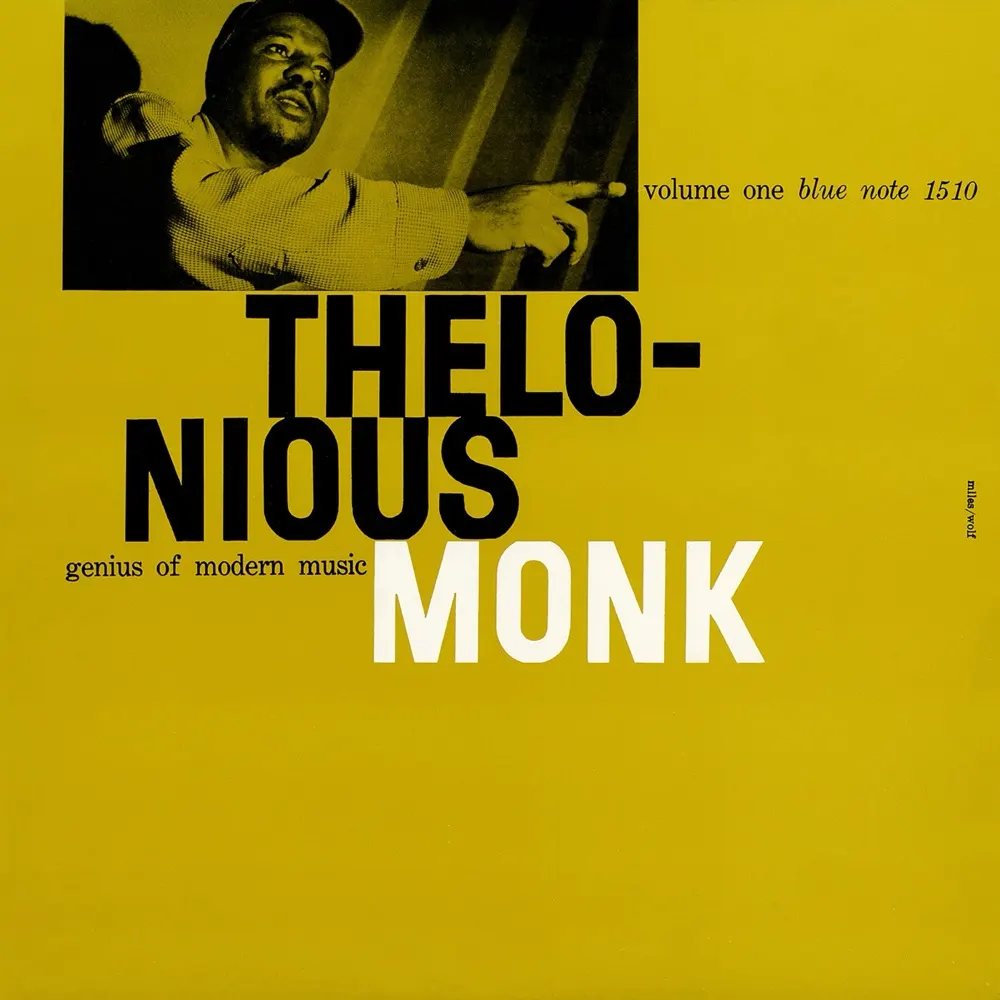
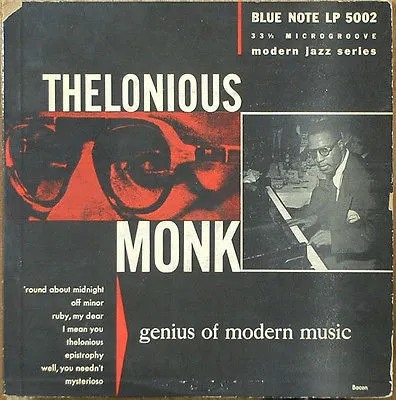
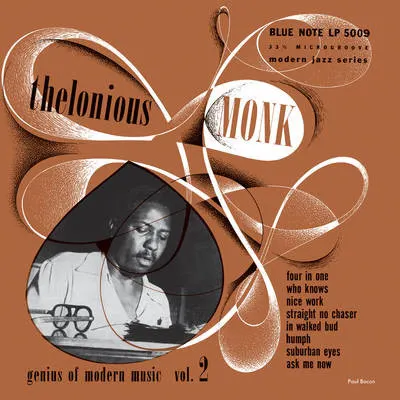
In 1947 Thelonious Monk was 30, a known name among musicians from the Minton's years and almost unknown to everyone else. The saxophonist Ike Quebec brought him to Alfred Lion and Lorraine Gordon at Blue Note, and Gordon took up his cause with a passion; she later remembered that the Harlem record shops wanted neither Monk nor her. Lion recorded him anyway. This record is not a single session but a gathering: his first dates as a leader and one more in 1948, issued first as 78s and then on two ten-inch LPs, Genius of Modern Music (BLP 5002) and its second volume (BLP 5009), and brought together on 12 inches in 1956.
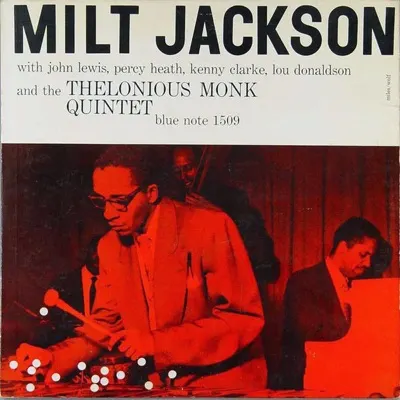
The music comes from four days. Three were at WOR Studios in New York in the autumn of 1947, with Art Blakey on drums each time: a sextet with Idrees Sulieman (spelled Suliman in the discography), Danny Quebec West and Billy Smith on October 15; a trio with Eugene Ramey on bass on October 24; and a quintet with George Taitt and Edmund Gregory on November 21. Gregory is the alto player later known as Sahib Shihab, the name Wikipedia uses. The fourth date, July 2, 1948, was at Apex Studios, with Milt Jackson on vibes, John Simmons on bass and Shadow Wilson on drums. Ira Gitler, in the original notes, sums up what all four bands were there to serve:
Monk's creativity is not limited to only the melodic or the harmonic or the rhythmic but embraces all three.
Ira Gitler, original liner notes
Side one opens with "'Round About Midnight", from the quintet date, a tune Gitler hears as having a sombre beauty. "Ruby My Dear", from the trio, is his example of sentiment that never turns sentimental. Side two begins with "Thelonious", built on one repeated note; Gitler points to its humour and to the striding left hand that ties Monk back to the older Harlem pianists. Next comes "Epistrophy", which Monk wrote with Kenny Clarke, where Gitler draws the ear to the give and take between Jackson and Monk. Near the end, "Introspection" was new to listeners in 1956: the Billboard review noted it had not been released before.
The wit and warmth are in abundance.
Ira Gitler, original liner notes
The rest of these sessions, and Monk's 1951 and 1952 Blue Note dates, went to Genius of Modern Music Volume 2 (BLP 1511). By 1956 Monk was recording for Riverside, and these tunes were already, as Gitler put it that year, a permanent part of the jazz library.