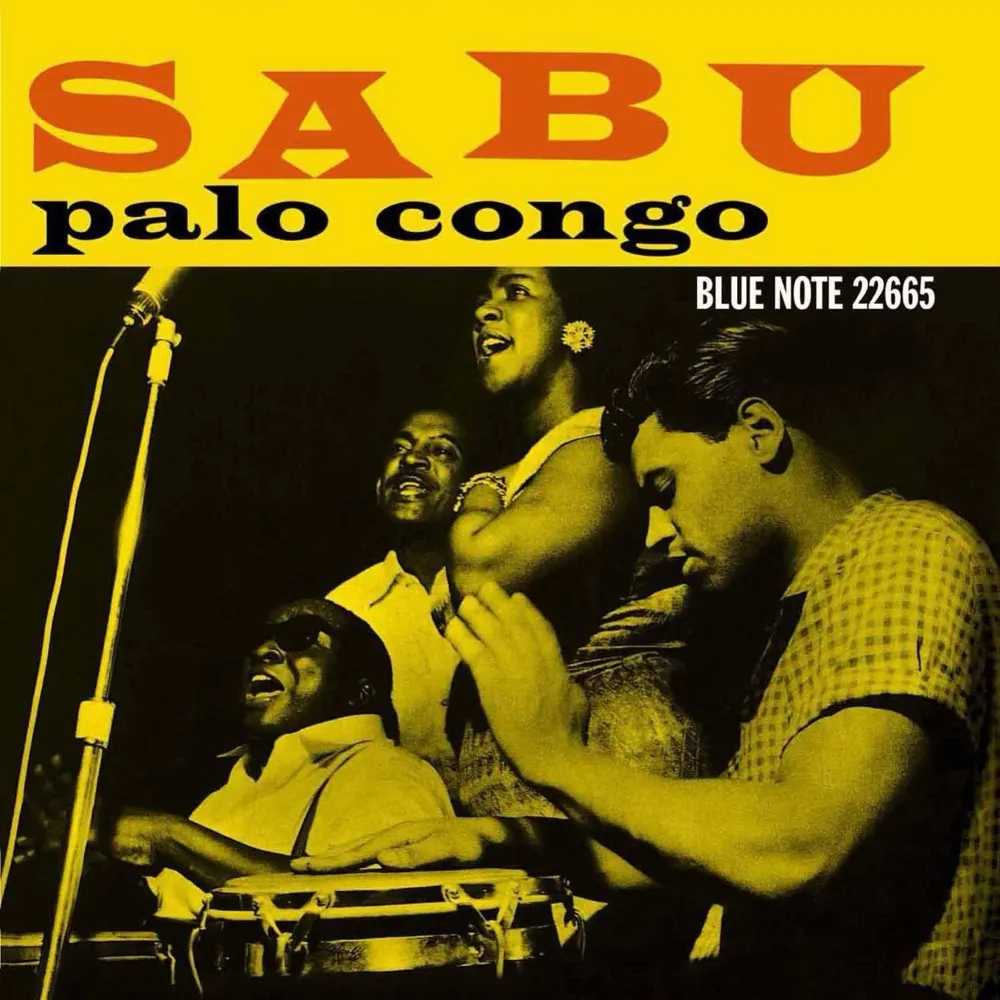
Sabu Martinez was a conga player who lived in two worlds. Hsio Wen Shih, in the original notes, has him turning professional at 11, in 1941, and working through the Latin bands of New York: Noro Morales, Miguelito Valdez, the first Joe Loco trio. On the jazz side he had played with Dizzy Gillespie, Charlie Parker, Thelonious Monk and Art Blakey. He had just formed a quintet of his own. For his first album as a leader, Shih writes, he leaned on the Latin half of that life.
The date was Sunday, April 28, 1957, at Manhattan Towers in New York, with Alfred Lion producing and Rudy Van Gelder at the controls. Wikipedia gives the date as April 27; the session listing has the 28th. This was not a jazz band. Arsenio Rodriguez, who had led one of the best bands in Cuba before coming to New York, played guitar, conga and sang. Raul "Caesar" Travieso, Israel "Quique" Travieso and Ray "Mosquito" Romero played congas, Evaristo Baro was on bass, and Sarah Baro and Willie Capo sang. Eight pieces were taped, and all eight are on the record.
Shih's view of what he heard was plain.
It is mostly Africa that we hear in this recording
Hsio Wen Shih, original liner notes
Side one opens with "El Cumbanchero." Sabu begins it with a vocal introduction, asking us to listen to the drum, and his solos on the quinto frame a guitar solo by Rodriguez. "Billumba-Palo Congo" is part of a religious ritual: Rodriguez leads the chanting, and the choir answers him. On "Choferito-Plena," Capo sings lead in a Puerto Rican style. "Asabache" is a showcase for four drums, each player on a different one.
Side two opens with "Simba," a chanted story of a lion hunt, with Sabu on cowbell. "Rhapsodia del Maravilloso" is Rodriguez alone on guitar. "Aggo Elegua" salutes Elegua, the Yoruba god of the crossroads. "Tribilin Cantore," the most Latin piece on the record by Shih's account, praises Cuba and ends with a bass solo from Baro.
Shih still heard a link to jazz, and he summed up the record as
a happy trip to a musical world with rather different rules
Hsio Wen Shih, original liner notes
The sleeve was designed by Reid Miles, with photography by Francis Wolff.
Not every jazz critic was ready. Jack Maher, in Metronome, worried that a record so purely rhythmic might wear out the average listener, though he thought Latin fans would love it. Billboard expected it to sell in the Latin market and to jazz fans who liked percussion.
Sabu followed it in 1958 with Safari with Sabu, and Wikipedia notes that Palo Congo later made the book 1001 Albums You Must Hear Before You Die.